

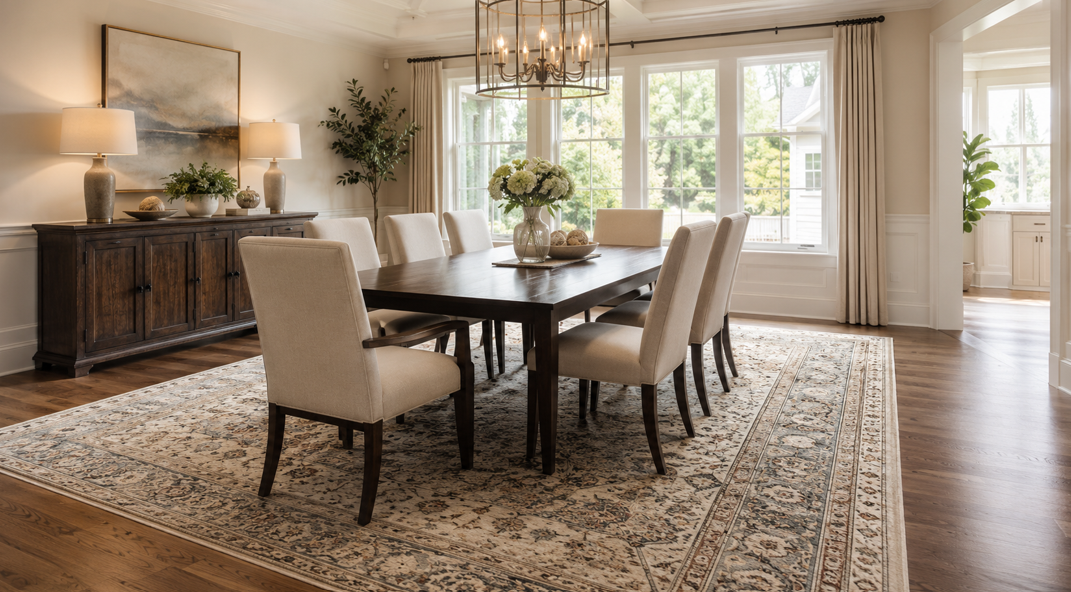
An area rug can completely change the way a dining room feels. The right size helps define the eating area, adds softness underfoot, protects hard flooring, and ties the table, chairs, lighting, and surrounding décor together. The wrong size can have the opposite effect. Chairs may catch on the rug edge, the room can look cramped, and a beautiful rug may feel disconnected from the furniture around it.
For homeowners in Brookfield, IL, dining rooms come in many shapes and sizes. Some homes have separate formal dining rooms, while others use open-concept layouts where the dining area shares space with the kitchen or living room. That means rug sizing is less about following one rigid rule and more about understanding how your table, chairs, room dimensions, and traffic flow work together.
With more than 27 years of experience serving local families, NPN Flooring helps homeowners bring flooring, rugs, and interior design choices together in a practical way. If you are choosing a dining room rug, the goal is simple: select a size that looks balanced while allowing everyone to pull out a chair comfortably.
Start With Your Dining Table, Not the Rug
The dining table is the best starting point because the rug needs to support the furniture that actually sits on it.
A rug can look large enough when every chair is pushed neatly under the table, but dining rooms are used in motion. People pull chairs out, sit down, stand up, and push chairs back again. The rug needs to account for all of that movement.
Measure the Table at Its Usual Size
Start by measuring the full length and width of your dining table. If you have a round table, measure its diameter.
Write these measurements down rather than relying on memory while shopping.
If your table has extension leaves, think about how frequently you use them. A household that only extends the table once a year may choose to size the rug around its everyday configuration. If you regularly host family dinners, holidays, or gatherings, it may make more sense to plan around the extended table.
Otherwise, a rug that looks perfectly proportioned during ordinary meals may suddenly seem undersized when the table grows.
Include Chair Movement in Your Measurements
Once you know the table dimensions, allow extra room on every side for the dining chairs.
A useful starting point is about 24 inches of rug beyond each edge of the table. In larger dining rooms, roughly 30 inches or more can provide even greater comfort.
This additional space gives the chairs room to move while keeping their legs supported by the rug.
The measurement does not have to be identical in every home. Chair depth, table size, room layout, and the way your family uses the dining space all influence how much clearance feels comfortable.
What matters most is avoiding a rug that ends immediately behind the chairs when they are pushed in.
Do a Real-Life Chair Test
Before choosing a rug size, sit at the dining table as you normally would.
Pull one chair back far enough to sit down comfortably, then measure from the edge of the table to the rear chair legs. Repeat the test on another side if the room has an unusual shape or tighter clearance.
This gives you a realistic idea of how far the rug needs to extend.
If the back legs repeatedly drop off the rug whenever someone pulls out a chair, the rug is probably too small. That can make chairs feel uneven and may cause the rug edge to shift or curl with repeated use.
Choose a Rug Shape That Works With the Table
Rug size matters, but shape also affects how balanced the dining area looks.
Your rug does not always have to match the exact shape of your dining table. However, certain combinations tend to create a more natural relationship between the furniture and the floor beneath it.
Rectangular Dining Tables
Rectangular dining tables usually pair naturally with rectangular rugs.
The matching proportions create a clean border around the table and make it easier to provide consistent chair clearance on each side.
For many six-seat rectangular tables, an 8-by-10-foot rug can be a useful starting point. Larger dining tables may need a 9-by-12-foot rug or something even larger.
These measurements are guidelines rather than guarantees. A wide six-seat table could require more space than a narrower eight-seat design.
Always let your actual table measurements guide the decision.
Round Dining Tables
A round dining table can look particularly polished over a round rug because repeating the shape creates a clear visual center.
That said, a round table does not require a round rug.
A square rug can work beautifully underneath a round table in a square dining room. A sufficiently large rectangular rug can also work when the room itself is rectangular.
The important detail is still chair clearance. The rug needs to extend far enough beyond the tabletop to support chairs when people are actually using them.
Square Dining Tables
Square dining tables often pair well with square rugs.
This combination creates symmetry and can look especially balanced in a square dining room or breakfast area.
A large round rug beneath a square table can offer a softer alternative when you want to introduce curves into a room dominated by straight architectural lines.
Oval Dining Tables
Oval dining tables generally work well with rectangular or oval rugs.
Rectangular options are available in many standard dimensions and can make sizing simpler. An oval rug can create a softer, more customized appearance.
Whichever shape you choose, aim for the table and chairs to read visually as one complete furniture grouping instead of making the table look as though it is sitting on a small decorative mat.
Match the Rug Size to Your Dining Room Dimensions
Once you know how much space your table and chairs require, compare that measurement with the dining room itself.
The ideal dining rug needs to be large enough for comfortable seating while still leaving appropriate space near walls, doors, storage furniture, and walkways.
Leave Some Visible Flooring Around the Rug
In a separate dining room, a visible border of flooring around the rug usually helps the room feel balanced.
Depending on the size of the space, approximately 12 to 24 inches of visible flooring between the rug and the walls can provide a useful starting point.
A very narrow border may make the rug appear squeezed into the room. Too much empty flooring, on the other hand, may make a small rug seem disconnected from the table.
The dimensions of the room itself matter here.
Brookfield homes can include features such as built-in cabinetry, radiators, narrower pathways, or architectural details that reduce the practical floor area. Measure the usable space rather than relying only on wall-to-wall dimensions.
Check Door Swings
Take note of every door near the dining area.
A rug that extends too far toward a doorway can interfere with a door opening or closing, particularly when the rug has a thicker pile.
Open each nearby door when measuring so you can see exactly how much floor clearance is available.
Protect Comfortable Walkways
Think about how people move through the dining space.
Can someone walk behind a seated guest without stepping awkwardly across a rug edge? Is there a path between the dining room and kitchen? Does the room connect with a hallway or exterior entrance?
A rug needs to support the furniture without creating an inconvenient boundary across frequently used walking routes.
Approach Open-Concept Spaces Differently
Open-concept rooms create another sizing challenge because the dining area may not have walls defining where it begins and ends.
In these spaces, an area rug becomes a visual boundary.
It tells the eye that the dining table and chairs belong together as one zone, even when a kitchen island or living room is only a few feet away.
The rug needs to be large enough to contain the full dining arrangement without visually competing with a nearby sofa grouping, kitchen furniture, or another rug.
Homeowners exploring area rugs can compare different sizes, shapes, textures, and designs to find an option that works with both their dining furniture and the wider room.
Use Common Rug Sizes as a Starting Point
Standard rug dimensions make shopping easier, but they work best as reference points.
A label such as 8 by 10 feet cannot tell you whether a rug is right for your dining room until you compare it with your furniture and available floor space.
5-by-8-Foot Rugs
A 5-by-8-foot rug may work under a very compact dining arrangement, but it is often too small for a full dining table and several chairs.
The table itself may fit comfortably while the chairs move beyond the rug as soon as someone sits down.
If you are considering this size, carefully measure the full working footprint of the table and chairs first.
6-by-9-Foot Rugs
A 6-by-9-foot rug can work for certain four-person dining sets and smaller dining rooms.
Again, do not judge the fit based solely on whether the table sits inside the rug's dimensions.
Pull the chairs out and make sure their rear legs remain supported.
8-by-10-Foot Rugs
An 8-by-10-foot rug is a popular starting point for many medium-sized dining spaces.
Depending on the furniture dimensions, it can often accommodate a six-person rectangular dining table with comfortable chair clearance.
It may also work beneath larger round or square tables.
9-by-12-Foot Rugs
A 9-by-12-foot rug can suit larger dining rooms and tables.
Many eight-seat dining arrangements benefit from the additional space because chairs can move freely while remaining within the rug's boundaries.
In a larger formal dining room, the bigger footprint can also make the furniture feel appropriately scaled to the room.
Larger and Custom Rug Sizes
Not every dining room fits neatly into standard rug dimensions.
You may have an unusually long table, a wider-than-average dining room, an open floor plan, or furniture that was selected specifically for the space.
In those situations, a custom-sized rug can produce a better result.
NPN Flooring offers custom area rugs and area rug binding, giving homeowners another option when standard dimensions provide either too much coverage or not enough.
The best rug size is ultimately the one that works with your actual room. Standard sizing can guide the process, but measurements taken inside your Brookfield home matter more.
Consider Material, Pile, and Everyday Dining Use
Size may be the focus of your decision, but a dining room rug also has to work in real life.
Dining chairs move across it regularly. Food gets dropped. Drinks can spill. Crumbs find their way underneath the table.
Choosing a rug that suits those everyday conditions can make the dining area easier to enjoy.
Think About How Easily Chairs Move
Very thick or high-pile rugs can make dining chairs harder to move.
A lower-profile rug generally provides smoother chair movement and can help the dining setup feel more stable.
That does not mean a dining rug needs to feel hard or flat. Many woven and low-to-medium pile designs provide comfort while still allowing chairs to slide in and out naturally.
Plan for Food and Drink Spills
Even careful households occasionally spill something at the dining table.
Think about how easily the rug material can be cleaned and whether the texture tends to hold onto crumbs.
A family dining room used three times a day may benefit from a material selected for practical upkeep and durability. A formal dining room used only occasionally may give homeowners more flexibility in texture and construction.
Always follow the rug manufacturer's care instructions when cleaning spills or stains.
Use Color and Pattern Practically
Pattern affects both style and everyday appearance.
A rug with a detailed pattern or mid-tone color can be more forgiving between cleanings than a very pale solid rug.
That can be useful in busy dining rooms.
Still, functionality should not completely dictate style. The rug needs to complement the flooring underneath it, dining table, chairs, wall color, light fixtures, and nearby décor.
A well-chosen pattern can connect those elements while giving the dining area its own identity.
Consider the Flooring Beneath the Rug
Area rugs can help protect sections of hardwood, laminate, tile, and other hard flooring from direct chair movement and everyday traffic.
The rug pad matters too.
Use a pad that is compatible with both the area rug and the flooring underneath it. The right option can help limit movement, add comfort, and reduce friction.
Avoid Common Dining Room Rug Sizing Mistakes
Many rug-sizing problems come from a few predictable mistakes.
Avoiding them can save you from bringing home a beautiful rug that simply does not work with the room.
Choosing a Rug That Only Fits the Table
This is one of the most common mistakes.
If the rug extends only slightly beyond the tabletop, chairs will usually move off it when someone sits down.
Measure the table and the working chair space as one complete footprint.
Buying Before Measuring the Room
A rug may look perfectly proportioned in a showroom or styled photograph and still be wrong for your home.
Before shopping, record:
Table length and width
Chair clearance
Available room dimensions
Door locations
Walkways
Nearby furniture
These measurements make comparing rug sizes much easier.
Forgetting About Table Extensions
If your table has leaves or extensions, consider how often you use them.
Homeowners who regularly host larger gatherings may want a rug that remains proportional when the table is extended.
Otherwise, the table and chairs can outgrow the rug precisely when the dining room is busiest.
Letting the Rug Crowd the Walls
Choosing a larger rug is often better than going too small, but bigger is not automatically better.
A rug that nearly touches every wall can lose the visual effect of being an area rug and may overwhelm a smaller dining room.
Try to maintain enough visible flooring to frame the rug naturally.
Ignoring Sideboards and Other Furniture
Dining rooms often contain more than a table and chairs.
Sideboards, buffets, china cabinets, benches, serving carts, and display furniture all affect the available floor space.
Decide whether those pieces will remain completely outside the rug or intentionally sit on it.
Avoid having a heavy storage cabinet partly resting on a rug edge unless the room layout specifically calls for that arrangement.
Guessing Instead of Testing
One of the easiest ways to test a proposed rug size requires no rug at all.
Use painter's tape to mark the dimensions on the floor.
Then interact with the room normally.
Pull out every chair. Walk behind the table. Open nearby doors. Stand in the kitchen or hallway and look back into the dining room.
Leave the tape in place long enough to see how the proposed dimensions feel during normal use.
This simple test can reveal whether a rug is too small, too large, or just right before you make a final selection.
Create a Dining Area That Looks Balanced and Feels Comfortable
The right dining room rug is not simply the largest option that fits or the closest standard size to your table.
It needs to support the way the dining area actually works.
Start with your table dimensions, then allow enough additional space for chairs to remain on the rug when people sit down or stand up. Compare that furniture footprint with the overall room, paying attention to walls, doors, walkways, and nearby storage pieces.
Next, think about shape. Rectangular rugs are natural partners for many rectangular tables, while round, square, and oval designs can create equally attractive arrangements when their proportions suit the room.
Common sizes such as 8 by 10 feet and 9 by 12 feet provide useful starting points, but they are not rules. A smaller, larger, or custom rug may be the better fit for your particular Brookfield dining room.
Material and construction deserve attention as well. Dining rooms benefit from rugs that allow smooth chair movement and fit the household's cleaning and maintenance preferences.
When size, shape, material, and design work together, an area rug does more than decorate the floor. It visually anchors the dining set, adds comfort, helps protect the flooring beneath it, and makes the entire space feel more intentional.
If you want personalized guidance choosing the right rug dimensions, style, or custom option for your dining room, get in touch with NPN Flooring to discuss your Brookfield home and design goals.


